

Affidavit of Service
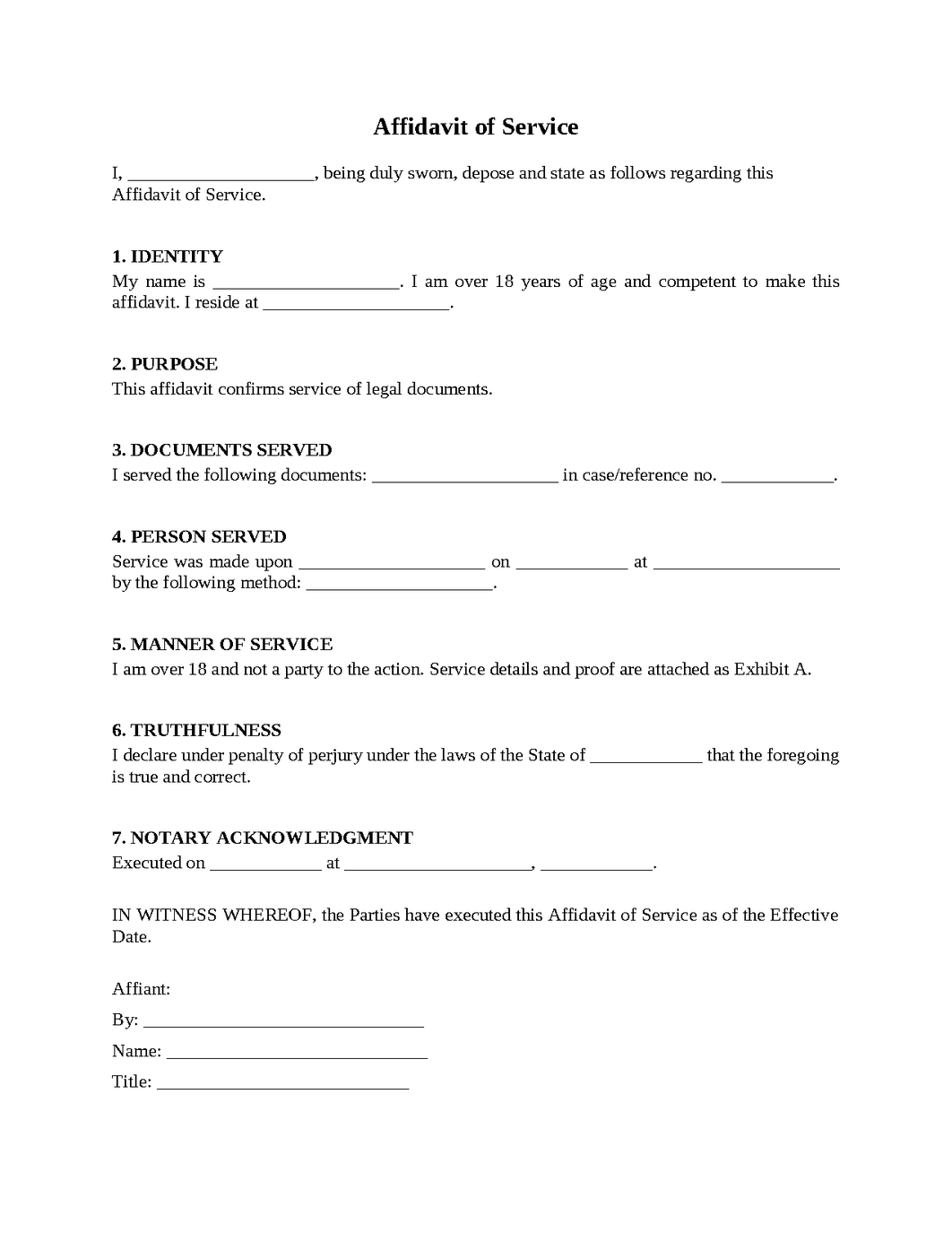
An Affidavit of Service is a sworn statement used to prove that legal documents were properly delivered to another party. Courts, attorneys, government agencies, process servers, and litigants frequently rely on this document to establish that notices, complaints, subpoenas, motions, petitions, and other legal papers were served according to applicable rules. The affidavit typically identifies who was served, what documents were delivered, when service occurred, where service occurred, and how the documents were delivered. Because legal proceedings often depend on proper notice, an Affidavit of Service plays a critical role in protecting due process rights and ensuring that cases can move forward. When service is challenged or documentation is incomplete, hearings may be delayed, judgments may be overturned, and legal disputes may become significantly more complicated.
A Defendant Claims They Never Received the Lawsuit
A business owner is sued by a former customer. Several months later, the plaintiff obtains a default judgment after the defendant fails to respond to the lawsuit. When collection efforts begin, the defendant argues that they never received the complaint and had no idea a lawsuit existed.
The court must now determine whether proper service occurred. If the defendant truly never received notice, serious due process concerns may exist. On the other hand, if the documents were served correctly, the defendant may simply be attempting to avoid the consequences of failing to respond.
Situations like this occur frequently in civil litigation. People move without updating addresses, refuse to answer doors, ignore legal papers, or later claim they were never notified. Without documentation showing how service occurred, courts may struggle to determine what actually happened.
The consequences can be substantial. Judgments may be challenged, hearings may need to be repeated, and legal costs can increase significantly. Plaintiffs may spend months attempting to enforce judgments while defendants seek to reopen cases.
An Affidavit of Service helps resolve these disputes by creating a sworn record of the service process. The affidavit documents who received the papers, where service occurred, and when delivery took place. This information often becomes critical evidence when service is challenged.
A Court Refuses to Proceed Because Service Cannot Be Proven
A landlord files an eviction action against a tenant. The hearing date arrives, and the tenant does not appear. The landlord expects the court to grant the requested relief immediately.
Instead, the judge asks for proof that the tenant received notice of the proceeding. The landlord explains that the documents were delivered but cannot provide adequate documentation showing when and how service occurred.
From the court's perspective, proof of service is essential. Before making decisions that affect legal rights, courts generally require evidence showing that all parties received appropriate notice and had an opportunity to participate.
Without proof of service, proceedings may be postponed. New service attempts may be required. Filing deadlines may need to be extended. Cases that appeared ready for resolution can suddenly face significant delays.
This problem is not limited to eviction proceedings. Similar issues arise in lawsuits, probate matters, family law cases, administrative hearings, and numerous other legal proceedings.
An Affidavit of Service provides the evidence courts often need before moving forward. By documenting service details in a sworn statement, the affidavit helps establish that notice requirements have been satisfied.
The Wrong Person Receives the Documents
A process server visits a residence to serve legal documents on an individual involved in a lawsuit. A person answers the door and accepts the papers. Believing service has been completed, the process server records the delivery and leaves.
Weeks later, the intended recipient argues that they never received the documents because the papers were given to a roommate who failed to pass them along. Questions immediately arise regarding whether service was legally sufficient.
Service requirements can be highly technical. Depending on applicable laws, delivering documents to the wrong person may invalidate service entirely. In other situations, substitute service may be permitted if certain requirements are satisfied.
Determining whether service was proper often requires careful review of the circumstances. Who received the documents? What was their relationship to the intended recipient? Did applicable rules allow service in that manner?
These questions frequently become important when deadlines are missed or judgments are entered. Parties may challenge outcomes by arguing that service requirements were never satisfied.
An Affidavit of Service helps preserve critical facts while memories remain fresh. By documenting exactly who received the documents and how service occurred, the affidavit provides evidence that can help resolve later disputes.
Service Is Attempted at an Outdated Address
A creditor files a lawsuit seeking repayment of a debt. The creditor relies on an address obtained from older records and arranges for service at that location.
The process server visits the address multiple times but cannot locate the defendant. Neighbors report that the individual moved several years earlier. Additional investigation becomes necessary before service can be completed.
This scenario occurs frequently because people change residences, businesses relocate, and records are not always updated promptly. Information that was accurate when an account was opened may no longer reflect the individual's current location.
The inability to locate a party can create substantial delays. Courts generally require reasonable efforts to serve individuals before allowing alternative methods of service. Additional searches, skip tracing, publication notices, and court approvals may become necessary.
The longer service remains incomplete, the longer the underlying legal matter remains unresolved. Costs increase and deadlines may be affected.
An Affidavit of Service helps document the efforts made to complete service, including unsuccessful attempts. These records can become important when courts evaluate whether additional service methods should be authorized.
A Judgment Is Challenged Years Later
A contractor obtains a judgment against a former client after the client fails to appear in court. Several years later, the contractor begins collection efforts and discovers valuable assets that may satisfy the judgment.
The former client responds by challenging the judgment and arguing that they were never properly served with the original lawsuit. Because substantial time has passed, memories have faded and many records are difficult to locate.
The court must determine whether proper notice was provided years earlier. Without reliable documentation, reconstructing what occurred can be challenging.
This type of dispute illustrates why service documentation remains important long after a case concludes. Judgments may be enforced years after entry. Appeals, collection actions, and collateral challenges may all require proof regarding what occurred at the beginning of the case.
An Affidavit of Service creates a contemporaneous record documenting the service process. Rather than relying on memory years later, parties can refer to the sworn statement prepared when service occurred.
Courts often view these records as important evidence because they capture details at the time of the event rather than relying on later recollections.
Proper notice is one of the foundational principles of the legal system. Before courts make decisions affecting rights, property, contracts, or obligations, parties generally must receive an opportunity to participate. Questions regarding whether documents were delivered, who received them, where service occurred, and whether legal requirements were satisfied frequently arise in litigation and administrative proceedings. An Affidavit of Service provides a formal method for documenting the service process and preserving important facts regarding delivery. When prepared accurately and supported by reliable information, the affidavit helps reduce disputes, support due process, and provide courts and parties with greater confidence that notice requirements have been satisfied.
:::

Get started with Upsign today!
Easily send, sign and track your documents